VityPatch™ Hydrogel | Advanced Wound Care for Healthcare Professionals
For Healthcare Professionals • Advanced Hydrogel Wound Dressing

Transform Wound Healing Outcomes with Advanced Hydrogel Technology

VityPatch™ Hydrogel is engineered to create the optimal healing environment, maintaining perfect moisture balance while supporting oxygen availability at the wound interface. Experience enhanced patient comfort and accelerated healing times.

ISO 10993-5/-10/-23 Tested Clinically Proven Medical-Grade Formulation Oxygen-Supportive Interface
Request Clinical Samples Review Clinical Data

Clinical Excellence in Wound Management

  • Optimal Moisture Balance – Creates the ideal environment for keratinocyte migration while preventing painful desiccation.
  • Enhanced Oxygen Availability – Supports cellular respiration for high-quality granulation tissue formation.
  • Protective Barrier Function – Cushions fragile neo-epidermis while reducing friction and discomfort.

Professional judgment determines suitability by wound type, exudate level, and overall care plan. Not all wounds are appropriate for hydrogel dressings.
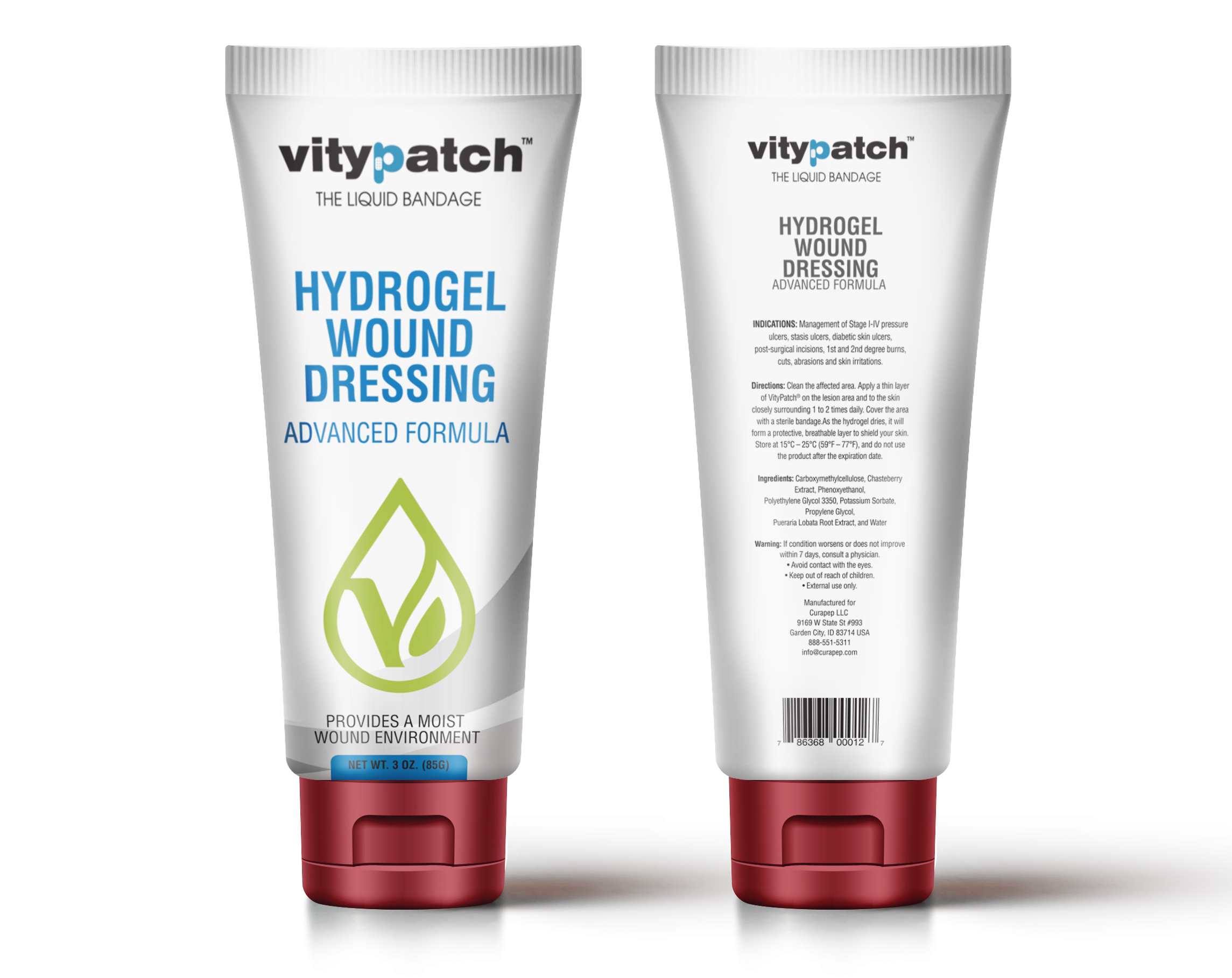
VityPatch Hydrogel tube and texture
Fragrance-free • Dye-free • Paraben-free

Demonstrated Clinical Outcomes

Post-Mohs secondary intention case series (n=21) showing significant improvements in healing times and patient outcomes with VityPatch Hydrogel implementation.

28 d
Median Time-to-Healing

3x faster healing time compared to historical benchmarks with reduced risk of complications.

100%
Healing Rate at 90 Days

Complete epithelialization achieved in all cases within three months, preventing chronic wounds.

0
Reported Adverse Events

No reported allergies, irritation, or adverse reactions in the series.

2–3 d
Rapid Pain Reduction

Patients reported notable reduction in discomfort within 2–3 days.

396 mm²
Median Wound Area

Effective across a range of wound sizes (range 80–5600 mm²).

Face
Cosmetic Region Success

Excellent cosmetic outcomes noted in facial regions including nose and forehead.

VityPatch Clinical Results

  • n=21 (secondary intention, post-Mohs)
  • Median TTH: 28 days (3x faster)
  • Healed ≤90 d: 100%
  • Reported device AEs: none

Historical Cohort Comparison

  • n=393 (surgical wounds, secondary intention)
  • Median TTH: 86 days
  • Healed: 81.4%
  • CI ranges: 75–130 days vs ~28.4–49.2 (VityPatch)

Patient Population (n=21)

  • Age: 54–90 years (median ~74)
  • Comorbidities: HTN ~76%; DM ~29%; Lipid disorders ~47%
  • Locations: Ear (6), Nose (6); majority head/neck

Selection, wound size/depth, and care protocols influence outcomes. Use clinical judgment to determine suitability for hydrogels by exudate level and wound bed condition.

Notes: Case series not randomized or controlled; comparative references are historical from published cohorts and are shown for context only. Ensure any external-facing claims are substantiated and aligned with local device marketing regulations.

Trusted by Healthcare Professionals

Clinical feedback from physicians who have incorporated VityPatch Hydrogel into their wound care protocols.

★★★★★
"The moisture balance and non-adherent interface make post-Mohs aftercare significantly easier for both patients and clinical staff between visits."
Dr. Samira Ajmal, MD, FAAD
Dermatologic Surgeon
★★★★★
"For superficial burns and donor sites, the soothing barrier and sustained hydration help maintain an optimal wound bed environment for healing."
Dr. Gavin N, MD
Plastic & Reconstructive Surgery
★★★★★
"Easy to apply, excellent patient-reported comfort, and integrates seamlessly within our moist-wound-care protocols with outstanding results."
Dr. Beksac D, DPM
Limb Preservation / Wound Care

Testimonials used with permission; on file. No compensation provided for these statements.

Advanced Wound Healing Technology

VityPatch™ Hydrogel represents a significant advancement in wound care technology, specifically formulated to accelerate healing while maximizing patient comfort. Our proprietary hydrogel matrix creates the ideal moist wound environment that supports the body's natural healing processes.

Clinical Applications: Post-procedural care (Mohs, laser), pressure ulcers, diabetic foot ulcers, venous stasis ulcers, surgical incisions, burns, abrasions, and traumatic wounds.

Listed with the FDA Top-rated by wound care specialists

Key Benefits

  • Highly Rated Topical Wound/Ulcer Treatment by Physicians
  • Optimal Moisture Retention Technology
  • Enhanced Oxygen Permeability
  • Antibiotic-Free Formula
  • Easy Application and Removal
Order for Your Practice Request Samples

Instructions for Use (Summary)

  • Cleanse wound per protocol. Gently pat dry surrounding skin.
  • Apply a thin, even layer to completely cover wound surface.
  • Cover with appropriate secondary dressing as needed.
  • Reapply 1–2 times daily or as directed based on exudate level.

For external use only. Discontinue if irritation occurs. Single-patient multiple-use tube; avoid tip contact; recap tightly after each use.

Ideal For These Wound Types

  • Partial-thickness wounds
  • Superficial burns
  • Donor sites
  • Abrasions
  • Post-procedural wounds
  • Low to moderately exuding wounds

Instruction of use of VityPatch Hydrogels for Medical Professionals

VityPatch Hydrogel: Clinical Application Protocol for Wound Management

Indications

VityPatch Hydrogel is indicated for the management of partial- and full-thickness wounds, including but not limited to: pressure injuries/ulcers (Stages 2-4), diabetic foot ulcers, venous leg ulcers, first- and second-degree burns, and donor sites. It is designed to maintain a moist wound environment, support autolytic debridement, and provide a soothing, cooling effect.

Contraindications

Third-degree burns, wounds with known hypersensitivity to hydrogel components, and wounds with established clinical signs of infection without concomitant appropriate antimicrobial therapy.

Pre-Procedure Preparation

  1. Aseptic Technique: Perform hand hygiene and don clean or sterile gloves.
  2. Assessment: Conduct a comprehensive wound assessment, including location, dimensions (length, width, depth, undermining/tunneling), tissue type (e.g., necrotic, slough, granulation, epithelial), exudate level, and peri-wound condition. Document findings.
  3. Gather Supplies: VityPatch Hydrogel, sterile saline irrigation solution, sterile gauze, appropriate secondary dressing (e.g., foam, alginate, transparent film), and fixation tape. Select secondary dressing based on wound exudate levels.

Application Techniques (Select Based on Wound Presentation)

Option 1: Shallow Wounds (Granulating or Epithelializing)

Procedure:

  1. Wound Bed Preparation: Irrigate the wound bed thoroughly with sterile saline to remove debris and residual gel. Gently pat the peri-wound skin dry.
  2. Gel Application: Apply a thin, even layer (approximately 5mm thick) of VityPatch directly to the wound bed, extending slightly beyond the wound margins.
  3. Secondary Dressing: Cover with a non-adherent silicone interface or a foam dressing for low to moderate exudate.

Rationale: This method hydrates the wound bed and supports moist wound healing without over-hydrating.

Option 2: Deep Wounds with Cavities, Sinus Tracks, or Undermining

Procedure:

  1. Cleansing & Debridement: Irrigate all wound cavities. Perform sharp or mechanical debridement of non-viable tissue as necessary.
  2. Packing Technique: Impregnate a sterile gauze strip or alginate rope with VityPatch Hydrogel. Gently and loosely pack the wound cavity, ensuring contact with all wound surfaces. Do not over-pack.
  3. Secondary Dressing: Cover with an absorptive secondary dressing like a foam pad to manage exudate.

Rationale: Fills dead space, delivers moisture to the wound base, and wicks exudate away from the wound bed.

Option 3: Wounds with Necrotic Eschar or Slough (for Autolytic Debridement)

Procedure:

  1. Cross-Hatching: If the eschar is stable and non-infected, cross-hatch the surface with a sterile scalpel to increase hydrogel.
  2. Application: Apply a thick layer of VityPatch directly onto the necrotic tissue.
  3. Occlusion: Cover with an occlusive or semi-occlusive secondary dressing (e.g., transparent film or hydrocolloid) to retain moisture.

Rationale: Creates an optimal environment for the body's enzymes to liquefy and separate non-viable tissue from the wound bed.

Dressing Change Frequency & Aftercare

  • Frequency: Change the dressing every 24 to 72 hours, or when strike-through (saturation of the secondary dressing) occurs. More frequent changes may be necessary during the active debridement phase.

At Each Dressing Change:

  • Gently irrigate the wound to remove all residual gel and liquefied slough.
  • Re-assess the wound for progress, noting any reduction in size, improvement in tissue quality (increased granulation, decreased slough), or signs of complications.
  • Re-apply VityPatch following the appropriate technique.

Monitoring and Management of Complications

  • Infection: Monitor closely for signs of infection (increased pain, erythema, edema, purulent exudate, odor, fever). If infection is suspected, obtain a wound culture and initiate appropriate systemic antimicrobial therapy. VityPatch can be used in conjunction with topical antimicrobials (e.g., silver, polyhexamethylene biguanide [PHMB]) as part of a comprehensive care plan.
  • Maceration: If peri-wound maceration occurs, reassess exudate levels. Consider a more absorptive secondary dressing (e.g., foam) or a barrier film to protect the peri-wound skin. Ensure gel is applied only to the wound bed, not the surrounding skin.
  • Lack of Progress: If the wound fails to show improvement after 2-4 weeks of consistent care, re-evaluate the overall treatment plan, including offloading, compression, vascular status, and nutritional support.

Note: This protocol is a clinical guideline. Treatment must be tailored to the individual patient based on a comprehensive assessment and clinical judgment.

Streamlined Reimbursement Support

Clinical Procedure Billing

  • Professional services are billed using appropriate CPT/HCPCS codes for wound care management.
  • VityPatch Hydrogel qualifies as a wound dressing (device) with coverage varying by payer policy.

Dressing & Supply Coverage

  • Hydrogels typically fall within the HCPCS A-code family for wound care dressings.
  • Payer-specific documentation and quick reference guides available upon request.

Need specific coding information? Access Our Comprehensive Billing Reference Guide .

This section is informational only and not coding or legal advice. Verify with each payer.

Ready to Enhance Your Wound Care Protocol?

Experience the VityPatch difference with clinical samples, practice pricing, and comprehensive support materials.

Request Evaluation Kit

Request Professional Samples & Information

Curapep 100% Satisfaction Guarantee

Curapep is committed to providing exceptional products and support to healthcare professionals. We stand behind our products with a comprehensive satisfaction guarantee for all direct orders.

If you are not completely satisfied with your experience, contact our Customer Service team for prompt resolution.

  • All returns credited to original payment method (excluding shipping/handling).
  • Allow up to 21 days for processing and 1–2 billing cycles for statement updates.
Email Customer Service Request a Clinical Support Call
Request Samples